Qualitative Meta-Aggregation in RevProHub
 by Shemsedin Amme
Published on May 30, 2026
Guides: Qualitative Meta-Aggregation
Meta-Aggregation
Theme Synthesis
60 minutes
Guides Objectives:
By the end of this session, users will be able to:
By the end of this session, users will be able to:
- Understand JBI Meta-Aggregation methodology for qualitative evidence synthesis
- Configure qualitative meta-aggregation analysis in RevProHub
- Map extraction form fields (Finding, Category, Excerpt, Credibility) to synthesis parameters
- Interpret synthesized findings with categories, findings, and illustrative excerpts
- Assess evidence density and credibility across aggregated themes
- Export qualitative synthesis results and add to manuscript
- Use AI Assistant for methodological feedback on qualitative synthesis
Part 1: What is Qualitative Meta-Aggregation?
JBI Meta-Aggregation is a systematic approach to synthesizing qualitative research findings. It aggregates findings into categories and synthesizes these categories into synthesized statements.
Findings
Individual themes from primary studies
Categories
Aggregated groups of similar findings
Synthesized Statements
Interpretive summaries
Credibility
Unequivocal / Credible / Unsupported
📖 JBI Framework: Findings are extracted as verbatim themes with illustrative quotes. Similar findings are grouped into categories. Categories are then aggregated into synthesized statements that represent the overall phenomenon.
Part 2: Configuring Qualitative Meta-Aggregation
Navigate to: Reporting Phase → Data Synthesis → Configure Analysis → Meta-Aggregation (Qualitative)
Step 1: Basic Information
- Analysis Name: "Meta-Aggregation: HIV/NCD Patient Lived Experiences"
- Select Data Extraction Form: "Qualitative Meta-Aggregation" (must contain fields for findings, excerpts, categories, credibility)
- Analysis Name: "Meta-Aggregation: HIV/NCD Patient Lived Experiences"
- Select Data Extraction Form: "Qualitative Meta-Aggregation" (must contain fields for findings, excerpts, categories, credibility)
Step 2: Select Studies
- Choose studies marked as "Included" after full-text screening
- Only studies with completed qualitative extraction data appear
- Choose studies marked as "Included" after full-text screening
- Only studies with completed qualitative extraction data appear
Step 3: Data Mapping & Settings
Map the following fields from your extraction form:
Map the following fields from your extraction form:
- Finding/Theme Field: The verbatim theme or finding
- Category Field: Your synthesized category
- Illustrative Excerpt Field: Direct participant quote
- Credibility Field: Unequivocal / Credible / Unsupported
- Page Number Field: Source page reference
⚙️ Field Mapping Importance: Correct mapping ensures RevProHub can properly aggregate findings by category, display illustrative quotes, and calculate evidence density (number of findings per category).
Part 3: Qualitative Extraction Form – Required Fields
| Field Name | Description | Example |
|---|---|---|
| Finding (Theme) | Verbatim theme from primary study | "Religion as a management strategy" |
| Illustrative Excerpt | Direct participant quote | "I believe God will heal me so I miss some doses..." |
| Category | Reviewer's synthesized category | "Cultural Beliefs" |
| Credibility | Unequivocal / Credible / Unsupported | Unequivocal |
| Page Number / Source | Study citation and page | Dube A (2025), p.14 |
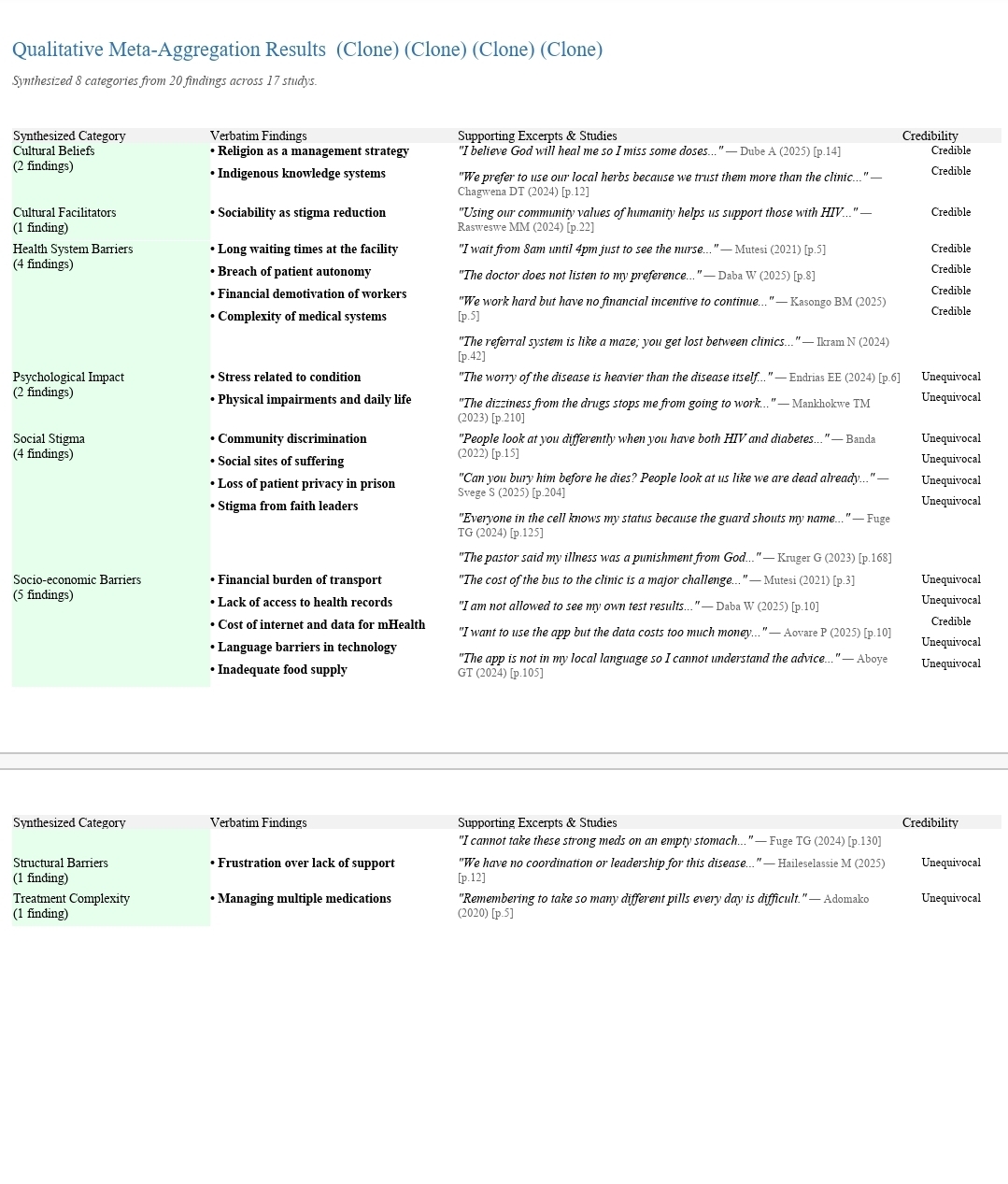
Part 4: Synthesized Results Output
Synthesized Qualitative Evidence (JBI Meta-Aggregation)
Summary: Synthesized 8 categories from 20 findings across 17 studies.
Category: Cultural Beliefs
Synthesized Statement: Evidence regarding Cultural Beliefs across 2 studies with 2 findings.
| Finding | Illustrative Excerpt | Credibility |
|---|---|---|
| "Religion as a management strategy" | "I believe God will heal me so I miss some doses..." Dube A (2025), p.14 | Credible |
| "Indigenous knowledge systems" | "We prefer to use our local herbs because we trust them..." Chagwena DT (2024), p.12 | Credible |
Category: Health System Barriers
Synthesized Statement: Evidence regarding Health System Barriers across 4 studies with 4 findings.
| Finding | Illustrative Excerpt | Credibility |
|---|---|---|
| "Long waiting times at the facility" | "I wait from 8am until 4pm just to see the nurse..." Mutesi (2021), p.5 | Credible |
| "Breach of patient autonomy" | "The doctor does not listen to my preference..." Daba W (2025), p.8 | Credible |
Category: Social Stigma
Synthesized Statement: Evidence regarding Social Stigma across 4 studies with 4 findings.
| Finding | Illustrative Excerpt | Credibility |
|---|---|---|
| "Community discrimination" | "People look at you differently when you have both HIV and diabetes..." Banda (2022), p.15 | Unequivocal |
| "Loss of patient privacy in prison" | "Everyone in the cell knows my status because the guard shouts my name..." Fuge TG (2024), p.125 | Unequivocal |
📊 Evidence Density Indicator: Shows number of findings per category – higher density indicates stronger thematic saturation.
Part 5: AI Assistant – Qualitative Interpretation & Methodological Feedback
Critical Interpretation:
The meta-aggregation reveals a thematic landscape heavily weighted toward systemic and external impediments rather than internal or cultural factors. 'Socio-economic Barriers' (5 studies), 'Social Stigma' (4 studies), and 'Health System Barriers' (4 studies) exhibit the highest conceptual saturation, suggesting these are the most robust and cross-validated drivers of the phenomenon. From a policy perspective, the high saturation of socio-economic and health system barriers suggests that interventions should prioritize structural reform rather than relying solely on educational or behavior-change initiatives.
Methodological Feedback:
The primary concern is uneven 'evidence density' across categories. Several categories based on single findings (n=1) risk 'noise' where idiosyncratic results might be mistaken for universal themes. Recommendations: (1) Use JBI ConQual to grade confidence in findings; (2) Conduct sensitivity analysis to check if overlapping studies are driving the synthesis; (3) Document whether categories reached thematic saturation.
Part 6: Credibility Levels (JBI ConQual)
Unequivocal (High)
Finding is directly supported by participant quotes with no contrary evidence
Finding is directly supported by participant quotes with no contrary evidence
Credible (Moderate)
Finding is plausible but not directly supported by verbatim quotes
Finding is plausible but not directly supported by verbatim quotes
Unsupported (Low)
Finding lacks sufficient supporting data
Finding lacks sufficient supporting data
📋 Use credibility ratings to assess the confidence in each finding. JBI ConQual system translates credibility + dependability into overall confidence scores (High/Moderate/Low).
Part 7: Export & Integration
Export as PDF
Full qualitative synthesis with tables
Full qualitative synthesis with tables
Export as DOCX
Editable for manuscript integration
Editable for manuscript integration
Add to Manuscript
Stage synthesis for Manuscript Editor
Stage synthesis for Manuscript Editor
Clone & Edit
Modify mapping and re-run analysis
Modify mapping and re-run analysis
🧪 Group Hands-On Activity: Qualitative Meta-Aggregation (50 min)
- Access Data Synthesis: Reporting Phase → Data Synthesis → Configure Analysis.
- Select Analysis Type: Choose "Meta-Aggregation (Qualitative)".
- Name Analysis: "Training Meta-Aggregation: HIV/NCD Experiences".
- Select Extraction Form: Choose "Qualitative Meta-Aggregation" form (created in Session 2.6.12).
- Select Studies: Choose 5-10 included qualitative studies with completed extraction data.
- Map Fields: Map Finding Field → finding_verbatim; Category Field → synthesis_category; Excerpt Field → illustrative_excerpt; Credibility Field → interpretation_credibility.
- Run Analysis: Click "Run Analysis". Wait for synthesis to complete.
- Review Results: Examine the synthesized table. Note categories, findings, illustrative excerpts, credibility ratings, and density indicators.
- AI Assistant Review: Expand AI Assistant section. Read the critical interpretation and methodological feedback. Copy key insights.
- Export Results: Export as PDF and DOCX. Click "Add to Manuscript" to stage for manuscript editor.
Debrief Questions:
- How does JBI meta-aggregation differ from thematic synthesis?
- What does evidence density tell you about a category's robustness?
- Why is credibility assessment important for qualitative evidence synthesis?
- How can AI Assistant feedback improve your qualitative synthesis methodology?
- When would you use meta-aggregation vs. meta-ethnography?
Best Practices for Qualitative Meta-Aggregation
Recommendations:
- Ensure each finding has a corresponding illustrative excerpt – improves credibility
- Group findings by conceptual similarity, not just keyword matching
- Aim for at least 2-3 findings per category for thematic saturation
- Include page numbers for traceability and auditability
- Use JBI ConQual to grade overall confidence in synthesized findings
- Report both categories with high AND low density – transparency about evidence gaps
- Include AI Assistant interpretation as supporting methodological reflection
Qualitative Synthesis Completion Checklist:
✔ Meta-aggregation analysis configured with correct field mapping
✔ Studies with completed qualitative extraction selected
✔ Findings aggregated into categories
✔ Synthesized statements generated for each category
✔ Evidence density reviewed (number of findings per category)
✔ Credibility ratings assessed (Unequivocal/Credible/Unsupported)
✔ AI Assistant interpretation reviewed and incorporated
✔ Results exported and/or added to manuscript
✔ Ready for qualitative findings reporting in manuscript
Next: Mixed-Methods Synthesis – integrating quantitative and qualitative evidence.